Earlier this week, the National Library of Norway launched new Norwegian language models in the Borealis series.
Borealis is a growing family of language models, containing models for Bokmål and Nynorsk, transcription models, work on text-to-speech models, and models for Sami.
Sigma2 provides the compute behind Borealis, and the ambition is to keep improving the models with national data.
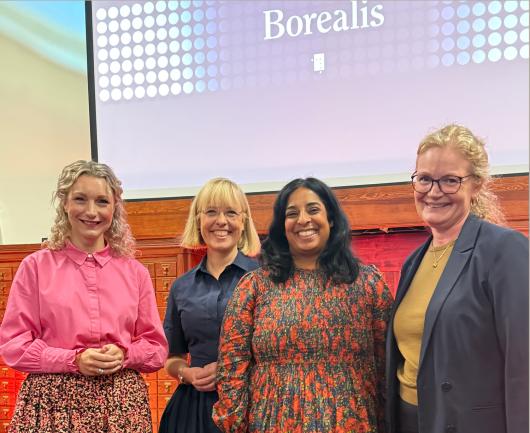
- In a few weeks, a 9th-grader in a Nowegian municipality will log on to a school laptop and ask a chatbot for help with homework. I should answer in Norwegian and understand Norwegian schools.
This is how Sigma2 CEO Hildegunn Vada opened her speech at the launch. The Borealis models are trained and tested using the national e-infrastructure, including supercomputers Olivia and LUMI. The National Library and Sigma2 are collaborating closely, and the current expansion of Olivia was, in fact, made in response to demand for AI development, including open language models for Norwegian and Sami.
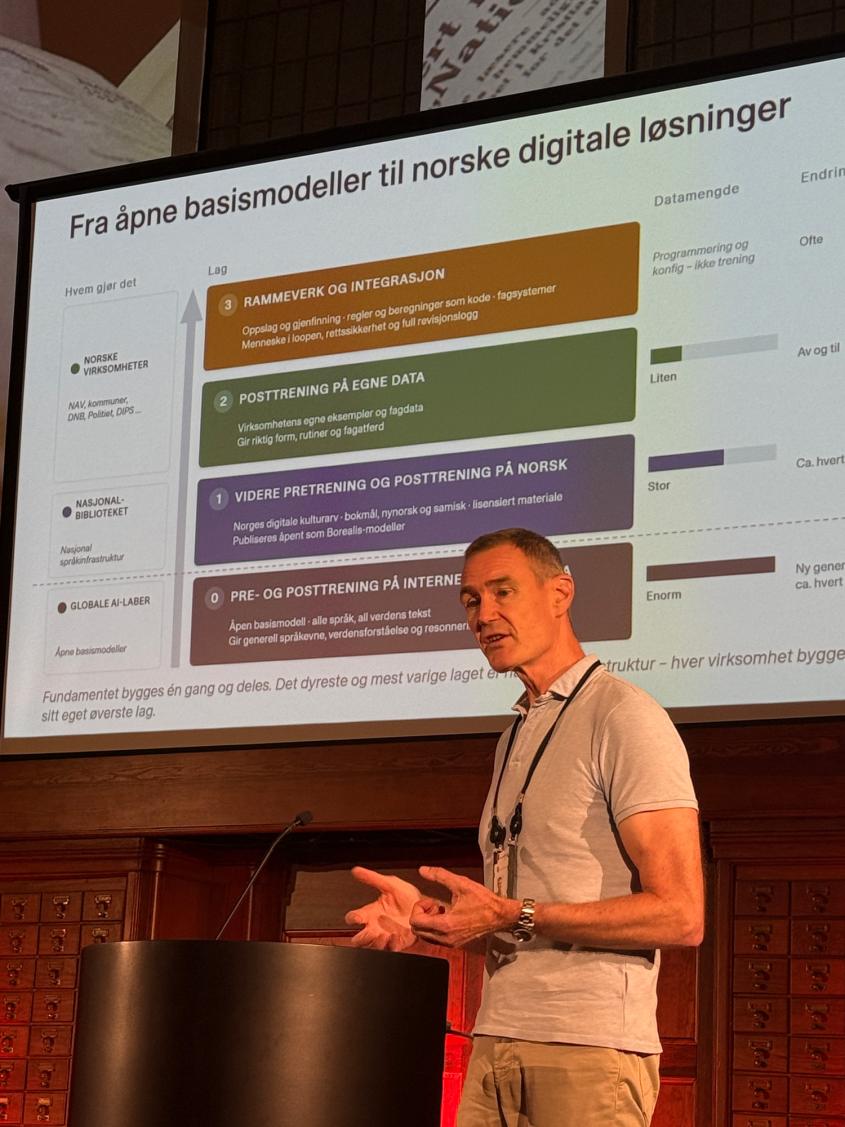
The launch itself also highlighted the importance of compensating publishers and obtaining access to copyrighted material when developing models like Borealis. The models are trained on copyrighted Norwegian newspaper text, which has been used in both pre-training and fine-tuning under an agreement that compensates publishers.
Two ministers were present at the event, and the message was clear. This is as much a language policy as a technology policy, and development cannot come at the expense of rights holders.
Whereas the Norwegian models cannot compete in size with the largest international language models, a model refined on a well-defined domain can most certainly outperform a far larger one in precisely that domain.
The pattern repeats wherever professional knowledge is specific to Norway. Health is a clear case: before AI services can be offered to clinicians, models need to be tested and quality-assured for the Norwegian clinical context.
However, open models are only half of the answer. They are freely available, but a public body or company still needs somewhere to test, adapt and quality-assure them before anything reaches a citizen or a customer.
That is what KI-fabrikken, our national AI Factory, is for. Through it, Sigma2 opens the capability that Borealis was built on to public administration and industry. This means a low-threshold environment for training and adapting models on Norwegian soil.