Global climate models often rely on decades-old code that is too rigid for modern supercomputers. Through Sigma2's Advanced User Support programme, an international team has made the spectral transforms of the atmospheric model SpeedyWeather.jl nearly six times faster on GPUs, making routine high-resolution climate simulations possible.

An international collaboration
Optimising a state-of-the-art global model requires bringing together expertise in meteorology, numerical modelling and high-performance software engineering. SpeedyWeather.jl is a fast, modular atmospheric model written in Julia. Milan Klöwer at the University of Oxford, who started the project, sees this as a milestone in its development. "Most of SpeedyWeather's kernels have been written by humans on laptops. Knowing that this code made it onto a supercomputer like LUMI is fantastic and a big step for the future," Klöwer says.
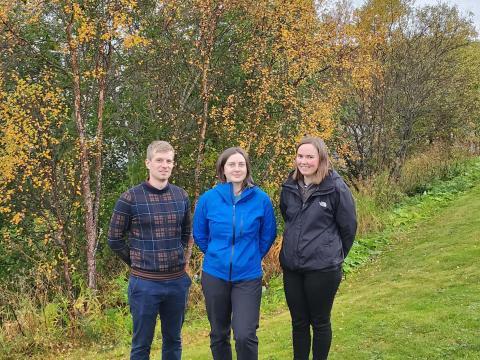
Through Sigma2's Advanced User Support (AUS) programme, UiT's Research Software Engineering group, Gregor Decristoforo, Julia Mikhailova, Marit Dagny Kristine Jenssen and Gabriel Gerez, worked with Klöwer and Maximilian Gelbrecht at the Potsdam Institute for Climate Impact Research to optimise SpeedyWeather.jl for Norway's national infrastructure, such as Olivia, as well as major European supercomputing facilities such as LUMI. Rune Graversen at UiT The Arctic University of Norway supervised the project, and his research group will use the model to simulate ice-free Arctic scenarios and their impact on climate systems.
Overcoming computational bottlenecks with GPU graphs
Many global weather prediction and climate models are based on spectral transforms, the most computationally intensive part of these models. To address this challenge, the team implemented GPU execution graphs using NVIDIA CUDA and AMD HIP technologies. By bundling these calculations into a single pre-scheduled pipeline on the graphics card, GPU graphs eliminate communication delays between processors.
Benchmarks showed a nearly six-fold speedup for SpeedyWeather.jl's spectral transforms. Memory allocations also dropped by two orders of magnitude, reducing computational overhead during high-resolution simulations.
Finally SpeedyWeather is actually really speedy on the GPU, this enables routine simulations at high resolution for our research.
Milan Klöwer, University of Oxford
Expanding portability and scientific reach
Beyond raw performance, the project expanded SpeedyWeather's hardware portability. The model now runs on AMD GPUs like those on LUMI as well as Apple Silicon laptops using Metal acceleration. Pushing these hardware boundaries also benefited the wider software ecosystem: during performance testing, the team identified a memory leak in Julia's AMDGPU package and uncovered a low-level compiler issue, which led directly to an upstream fix in the core LLVM project.
The addition of full 3D particle tracking allows researchers to observe atmospheric flows vertically as well as horizontally. Together, these advancements make SpeedyWeather.jl a high-performance, open-source tool for both climate research and education.
About SpeedyWeather.jl
SpeedyWeather.jl is an open-source, Julia-based global atmospheric model designed to scale from personal laptops to national and European supercomputing infrastructure. The project is available on GitHub. Read the SpeedyWeather.jl documentation to get started.