When UiO researcher Lucía Moran Gonzalez wanted to run SCINE Chemoton, an open-source framework for automated exploration of chemical reaction networks, on Sigma2 infrastructure, she faced a challenge.
Chemoton relies on a persistent MongoDB database and a continuously running manager process, making it difficult to run efficiently in a traditional batch-oriented HPC environment.
Exploring chemical reaction networks at scale
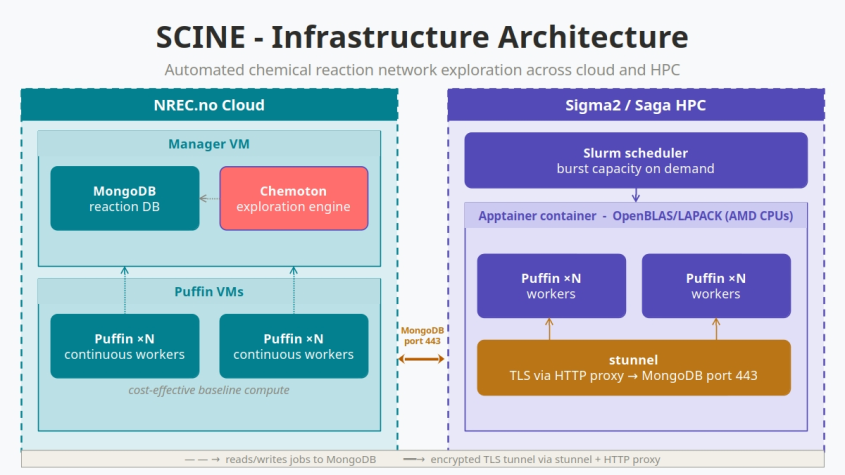
Working together with NRIS experts Jean Iaquinta and Nikolay Vazov, they developed a hybrid solution that combines the strengths of both NREC and Sigma2's HPC resources.
The database and Chemoton manager are hosted on dedicated NREC virtual machines, providing a stable environment for services that need to run continuously. Computationally intensive tasks are handled by SCINE Puffin workers running both on additional NREC instances and on Sigma2 HPC clusters. This setup allows Lucía to maintain a cost-effective baseline capacity while scaling up computations whenever needed by submitting additional Slurm jobs to the HPC systems.
The best of both worlds: NREC and HPC
NRIS support covered the full implementation, from provisioning and configuring the NREC infrastructure to integrating the workflow with Sigma2's HPC resources. The team adapted software containers for compatibility with the cluster architecture, established secure communication between services, and developed job scripts for launching large numbers of parallel workers.
As a result, Lucía can now scale her computational environment in both directions: by adding new virtual machines in NREC or by increasing the number of HPC jobs. The setup also enables real-time monitoring and visualisation of the growing reaction network as new compounds and reactions are discovered.
Thousands of compounds discovered automatically
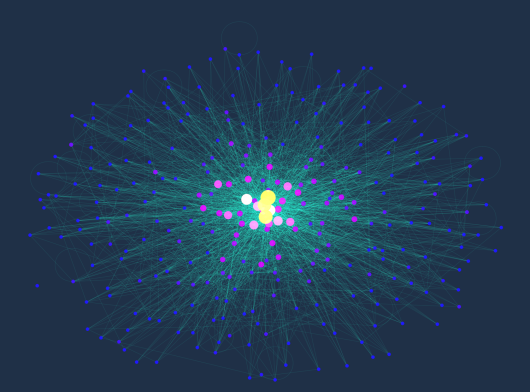
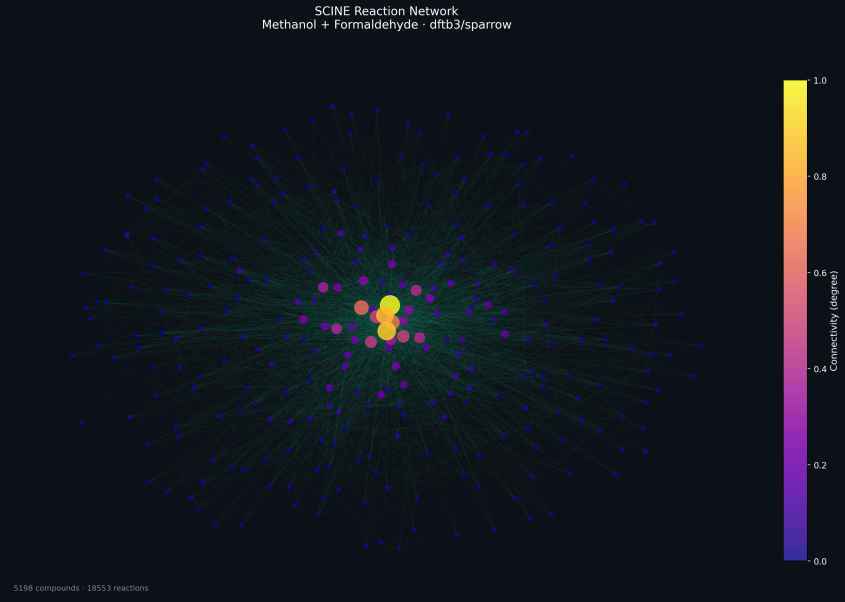
The figure below shows an example of an automatically generated reaction network for methanol and formaldehyde. Starting from just two molecules, Chemoton identified more than 5,000 distinct compounds connected through over 18,000 reaction steps, demonstrating the power of combining advanced scientific software with flexible national e-infrastructure.
While every research project has unique requirements, this case demonstrates how collaboration between researchers and NRIS experts can help overcome technical challenges and unlock new possibilities. Researchers are encouraged to contact NRIS Support for guidance on how to make the best use of national e-infrastructure services.