Moving established research workflows from one supercomputer to another can often feel daunting, especially when shifting hardware architectures.
However, a recent collaboration between NMBU (Norwegian University of Life Sciences) and the NRIS High-Level Support Team demonstrates that the transition is not only manageable. It can yield massive performance gains.
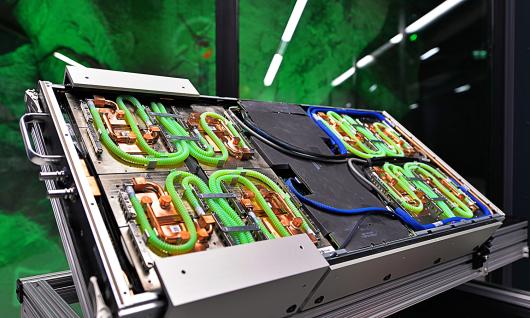
This is the story of how the Amber24 molecular dynamics package found a new home on Olivia, Norway's first system featuring the NVIDIA GH200 Grace Hopper Superchip.
The Challenge: Moving from x86 to ARM
Researchers Åsmund Røhr Kjendseth and Eirin Landsem Dalleywater at NMBU were successfully running Amber24 simulations on Saga. To take advantage of next-generation hardware, they wanted to migrate their workload to Olivia.
However, Olivia runs on the ARM64 architecture, distinct from the x86 architecture found on Saga. Porting complex software like Amber24 isn't always a simple "copy-paste." The team faced compatibility hurdles, and the need for specific CUDA build environments for the ARM partition.
The Solution: Extended support & containerisation
Through NRIS Extended Support, the researchers were paired with Senior Engineer Magnar Bjørgve. Rather than trying to force a standard installation directly onto the system, the solution lay in Apptainer.
Magnar built a custom container image optimised for the NVIDIA GH200 architecture. The solution involved building a container based on nvidia/cuda:12.8.0-devel-ubuntu22.04 and manually compiling Amber24 with CUDA support enabled, specifically targeting the ARM architecture.
The Result: 2x-3x speedup
The effort to migrate paid off immediately. After deploying the container to the project folder, Åsmund reported significant performance improvements:
—From the test, I see speedups of x2-x3 comparing single GPUs on Olivia and Saga, Åsmund Røhr Kjendseth, NMBU.
By moving to Olivia, the research group can now complete simulations in a third of the time, drastically accelerating their scientific output.
How you can do it, too
This story highlights that you don't need to be an HPC expert to use Olivia. The NRIS High-Level Support Team is available to help bridge the gap.
Key Takeaways:
- Don't fear the architecture: ARM compatibility is excellent, and where it fails, containers may provide a solution.
- Performance awaits: Both the 128 core AMD Turin CPUs in the CPU-partition and the NVIDIA GH200 chips offer significant speedups.
- We are here to help: If you have software that is difficult to install or port, apply for Extended Support. We can build the containers for you and provide the "recipes" (definition files) so you can focus on your research.
Ready to move your workload?
If you are running heavy GPU jobs on Saga and want to experience the speed of Olivia, contact us at support@nris.no or apply for Extended Support today.
Contributor
Magnar Bjørgve, Leader of the NRIS High-Level Support Team