In close collaboration with the Research Allocation Committee, we have now finalised the evaluation of research applications for the latest allocation period.
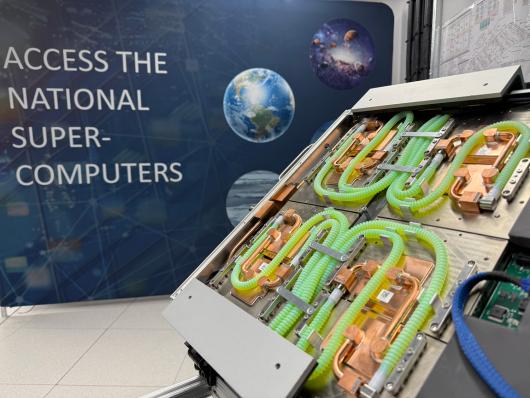
As we approach the final months of 2026, the national e-infrastructure landscape has experienced unprecedented growth, currently serving an active community of well over 2000 researchers, scientists, and analysts who rely daily on the robust computing capabilities provided by Sigma2.
To power these complex computational workloads and foster groundbreaking discoveries across diverse scientific disciplines, more than 725 million CPU-hours and 2 606 000 GPU-hours have been strategically allocated across nearly 400 distinct research projects.
Furthermore, the immense data demands of modern scientific inquiry are actively supported by robust storage solutions, with more than 220 projects securing a combined capacity approaching more than 30 petabytes across the national scientific data storage facilities.
HPC
Geoscience and physics consume the most computer time
The HPC customers from the scientific fields of computational fluid dynamics and biosciences are the largest group of researchers in need of computing resources. The size of computing projects in terms of consumed CPU-hours has grown year after year. In the ongoing allocation period, the largest individual computation project is Scientific insights into H2 combustion under elevated pressure conditions led by Andrea Gruber, at SINTEF. The project will consume no less than 150 million core-hours in the ongoing allocation period.
HPC: Top 6 projects
- Andrea Gruber: Scientific insights into H2 combustion under elevated pressure conditions (InsigH2t)
Allocated: 150 million CPU-hours - Mats Carlsson: Solar Atmospheric Modelling
Allocated 140 million CPU-hours - Noel Keenlyside: Bjerknes Climate Prediction Unit
Allocated 60 million CPU-hours - Michael Schultz: Computing for INES - Infrastructure for Norwegian Earth System modelling
Allocated 45 million CPU-hours - Ane Nordlie Johansen: CICERO Climate System Computations
Allocated 24 million CPU-hours - Noel Keenlyside: Synchronisation to enhance reliability of climate prediction
Allocated 14 million CPU-hours
Climate research dominates our top storage users. The largest individual storage footprint this period belongs to Michael Scultz’s geoscience-project Storage for INES - Infrastructure for Norwegian Earth System modelling which requires 2200 terabytes to store its ongoing research output.
Storage: Top 6 projects
- Michael Schultz: Storage for INES - Infrastructure for Norwegian Earth System modelling
Allocated 2200 Terabyte - Mats Bentsen: Storage for nationally coordinated NorESM experiments
Allocated: 1800 Terabyte - Noel Keenlyside: Bjerknes Climate Prediction Unit
Allocated 1800 Terabyte - Noel Keenlyside: Development and testing of a super climate modelling
Allocated 1250 Terabyte - Kristin Krüger: Transport And Chemistry of Climate and Ozone relevant trace gases
Allocated 1000 Terabyte - Stephan Oepen: High-Performance Language Technologies
Allocated 1000 Terabyte
Did you miss the deadline?
You can submit your proposal at any time, even outside regular application calls. Applications submitted after the application deadline for the new period are case handled after the period has started. Within a period, all applications are handled continuously. However, old projects applying after the deadline or after the period has started, receive lower queue priority (cost command nonpri quota).
If a project exhausts its allocations before the end of the ongoing allocation period, the project manager can submit a request for an extra allocation for the remainder of the period. There are no deadlines for such requests. Requests for extra allocations are subject to available capacity on the facilities. This also applies to proposals submitted outside regular calls.